Most GTM strategies do not fail. They never really existed.
Ask most B2B companies for their go-to-market strategy and what you usually get back is a list of channels, a planning deck, or a vague statement about "driving demand."
That is not strategy.
A real go-to-market strategy answers a much harder question: how does the company reliably turn market opportunity into pipeline and revenue?
If TAM analysis defines the size of the opportunity, and a clear Ideal Customer Profile defines who is most likely to buy, GTM is the execution layer that turns both into a system for growth.
What a GTM Strategy Actually Is
A go-to-market strategy is not a list of tactics.
It is not SEO, paid ads, outbound, events, LinkedIn, or content in isolation. Those are channels and programs.
A GTM strategy is the operating system behind growth. It defines:
- who the company targets first
- what message will resonate
- which channels deserve investment
- how sales and marketing work together
- how pipeline gets created predictably
That is the difference between random activity and an actual revenue engine.
How TAM and ICP Feed GTM
A good GTM strategy does not start from scratch. It sits on top of two foundational decisions.
TAM analysis tells you whether the market is large enough and where the real opportunity exists.
Your ICP tells you which buyers are the best fit based on pain, urgency, budget, buying motion, and expected lifetime value.
Once those are clear, GTM becomes a prioritization exercise: where do we focus first, what do we say, how do we reach them, and how do we convert that into pipeline?
Without TAM
Teams chase markets that are too small or too vague to support real revenue targets.
Without ICP
Teams target accounts that look right on paper but never convert, inflating pipeline volume while degrading pipeline quality.
Without GTM
Everything turns into disconnected marketing activity. No system. No compounding. No predictable pipeline.
The Four Core Parts of a Real GTM Strategy
1. Segmentation
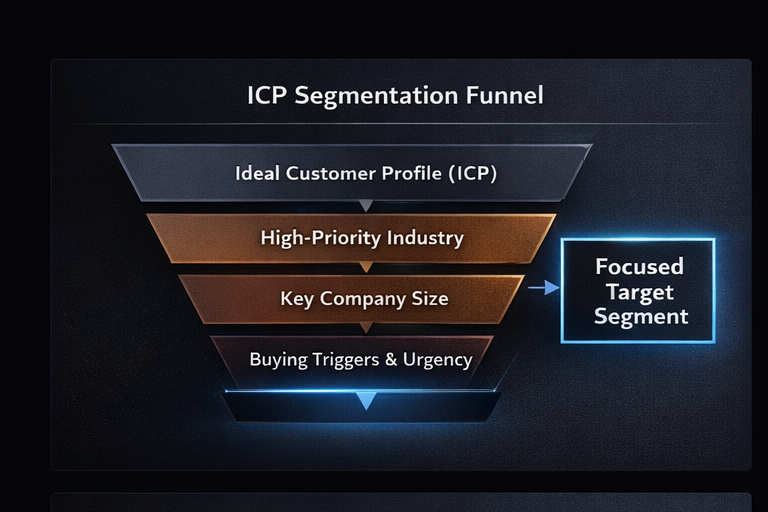
Not every account inside your ICP deserves equal focus.
The strongest GTM strategies narrow further by segment to identify who is most likely to buy now, not just who could theoretically benefit:
- industry vertical
- company size and revenue band
- maturity stage
- trigger events and buying urgency
- expected sales velocity
The goal is not just to define who could buy. It is to define who is most likely to buy now.
2. Messaging
Once segments are clear, messaging has to do real work.
Weak messaging stays generic: drive growth, increase efficiency, improve performance. Strong messaging is segment-specific and outcome-driven.
It speaks directly to the pain the buyer already feels and connects your offer to business results, not vague benefits. Every segment may require its own message framework — same product, different urgency, different outcome language.
3. Channel Selection
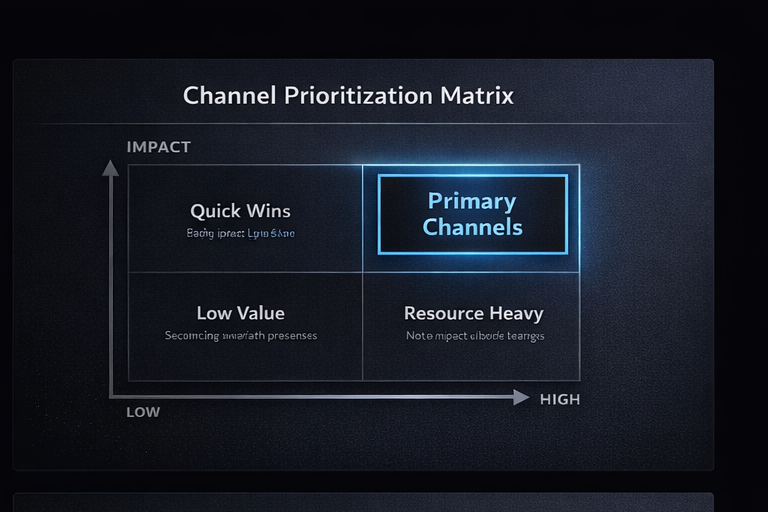
Most teams spread too thin. A real GTM strategy does not try to be everywhere. It identifies the one to three channels most likely to produce attention, trust, and pipeline from the defined ICP.
Depending on the company and segment, that could mean:
- outbound prospecting
- LinkedIn organic and paid
- SEO and content
- partner and referral channels
- events and communities
- paid search
- account-based programs
The key question is not "what channels exist?" It is "where does this buyer actually engage, and where can we win efficiently?" For a deeper look at how to evaluate and sequence specific channels, see the B2B demand generation strategy guide.
4. GTM Motion
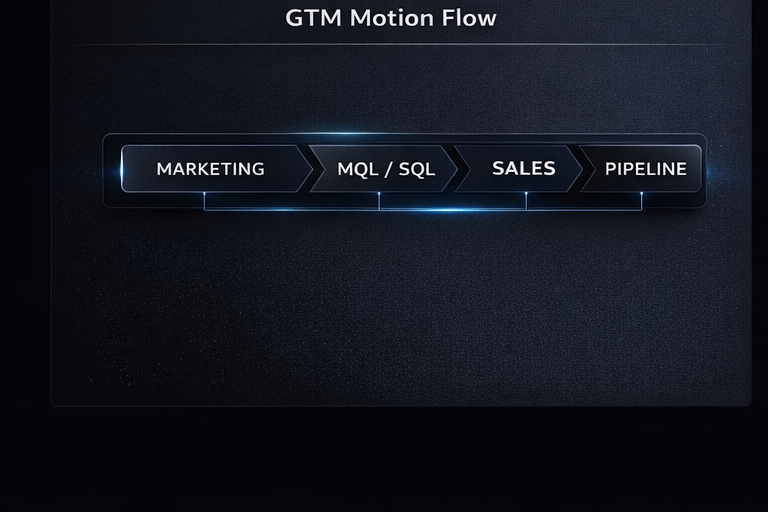
This is where strategy becomes real. A GTM motion defines how pipeline is actually created across marketing and sales.
Common GTM motions include:
- marketing-led motion
- sales-led motion
- founder-led motion
- hybrid inbound and outbound
- account-based motion
If this is not defined clearly, pipeline generation becomes chaotic. Marketing creates activity. Sales complains about lead quality. Leadership loses visibility. Revenue slows down.
For companies running a hybrid or inbound-led motion, see the B2B Inbound Pipeline Playbook — a full framework for building SEO, Google Ads, and referral demand capture into consistent pipeline.
Why Most GTM Strategies Break in Execution
Most companies do not fail because they chose the wrong concept. They fail because of missing focus, poor sequencing, unclear ownership, and no feedback loops.
Too many channels at once
Launching five channels simultaneously before any single one has proven traction. Spreading budget and attention too thin to build momentum anywhere.
Unclear ownership between sales and marketing
No agreed definition of pipeline, lead quality, or handoff criteria. Marketing measures MQLs. Sales ignores them. Neither team is accountable to revenue.
Weak messaging across every segment
The same generic positioning applied to every segment, channel, and audience. Messaging that feels written for nobody in particular converts accordingly.
No pipeline math behind targets
Revenue targets set without working backwards through pipeline conversion rates, opportunity volume, and account coverage. Goals are aspirational, not operational.
Constant strategic resets
Pivoting to a new approach every quarter before the previous one has had time to compound. A strong GTM strategy is not complicated because it includes more — it is strong because it excludes more.
GTM Is Ultimately a Pipeline Math Problem
At some point, every strategy has to hit revenue reality. A strong GTM plan should connect directly to pipeline math:
- revenue target
- average contract value
- close rate by stage
- opportunities required
- target account volume
Example
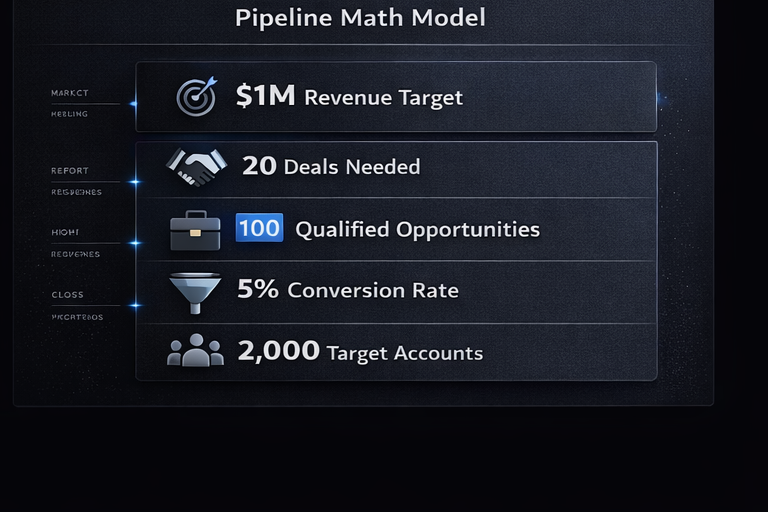
Revenue goal: $1M
Average deal size: $50k → you need 20 closed deals
Close rate: 20% → you need 100 qualified opportunities
Account-to-pipeline conversion: 5% → you need roughly 2,000 relevant target accounts
That is what GTM clarity looks like. Not activity. Not dashboards. Actual math tied to growth.
How to Build a Real GTM Strategy
A practical GTM strategy follows this sequence. Most companies need help not because the theory is hard, but because disciplined prioritization is hard.
Define the total market opportunity
Use bottom-up TAM analysis to understand the real size of the addressable market — not a number lifted from a research report.
Narrow to the Ideal Customer Profile
Build a tight ICP definition grounded in data from your best existing customers — firmographics, operational signals, pain intensity, and buying readiness.
Prioritize the highest-value segments
Within your ICP, identify segments with the strongest buying urgency, fastest sales velocity, and highest expected lifetime value. Focus there first.
Build messaging around business outcomes
Develop segment-specific messaging that connects your offer to the revenue and operational outcomes buyers already care about.
Select the most efficient demand channels
Choose one to three channels where your ICP actually engages. Build depth before adding breadth.
Define the GTM motion across teams
Align sales and marketing around a shared pipeline creation model — who owns what, how handoffs work, and how both teams are measured against revenue outcomes.
Model pipeline math backwards from revenue goals
Set targets that are grounded in conversion reality — close rate, ACV, opportunity volume, and account coverage. Make the math visible.
Execute, measure, and iterate
A GTM strategy is not a document. It is an operating system. Run it, measure it against pipeline outcomes, and sharpen it over time.
The Bottom Line
Most B2B companies do not need more tactics. They need more clarity.
When TAM, ICP, segmentation, messaging, channels, and pipeline math are aligned, go-to-market starts to work like a system.
When they are not aligned, growth becomes much harder than it needs to be.
If your GTM strategy feels fragmented, or your team is generating activity without consistent pipeline, that usually points to a strategy issue upstream — not an execution problem. It also raises the question of who owns the GTM system and whether the leadership model fits where the business actually is.