Pipeline Strategy

B2B Outbound Pipeline Playbook: How to Generate High-Quality Opportunities (Without Burning Your Market)

An operator-level playbook for building precise account lists, targeting the right buying committee, coordinating email, calls, and LinkedIn, and turning outbound activity into qualified pipeline.

12 min read Apex GTM
Executive Summary
  • Most outbound fails before a single email is sent — bad targeting, weak ICP, and missing infrastructure kill performance upstream.
  • Outbound is a precision system, not a volume game. Better lists produce more pipeline with fewer touches.
  • Multi-channel coordination beats single-channel volume every time.
  • Deliverability is infrastructure. If emails don't land, none of the rest matters.
  • Outbound is one of the fastest ways to generate qualified pipeline on demand — when the system is built correctly.

Most outbound doesn't fail because of email copy

It fails because of bad targeting, an unclear ICP, and no system behind the activity.

Most teams jump straight to tools and sequences — without fixing the inputs first.

Outbound is not a volume game. It is a precision system for creating pipeline on demand. The teams that treat it like one produce consistent opportunities. The ones that treat it like a spray-and-pray email blast burn their market and wonder why nothing converts.

Outbound Fails Before It Starts

Most outbound teams focus on the wrong things:

  • which tools to use
  • how to write sequences
  • what sending volume to hit

But outbound performance is driven upstream by inputs most teams never get right:

  • how well the market is defined
  • how precise the account selection is
  • how clearly the persona is mapped
  • how relevant the message is to the specific situation
  • how solid the sending infrastructure is

Weak inputs create weak pipeline. Not weak effort — weak precision.

Precision always outperforms volume in outbound. The constraint is rarely how many emails you send — it's who you send them to and why.

Start with Market Reality (TAM → ICP → SOM)

Before writing a single sequence, you need a clear market map.

TAM analysis defines the full scope of your opportunity. But outbound does not operate at the TAM level — it operates at the SOM level. The specific slice of the market you can realistically reach, engage, and convert with current capacity.

TAM

Total possible market ceiling

SAM

Market your ICP and model can serve

SOM

Where outbound actually operates

Once your market is mapped, the next step is defining your Ideal Customer Profile with enough precision to build an account list that actually converts. An ICP that is too broad produces a list that looks large and performs poorly.

Outbound amplifies strategy. It does not replace it. If the strategy inputs are weak, more outbound volume makes the problem worse — not better.

Building a High-Quality Target Account List

List quality determines everything downstream. A precise list with 500 accounts will outperform a bloated list of 5,000 nearly every time.

Start with the firmographic filters that reflect your actual ICP:

  • industry and sub-vertical
  • company size (headcount or revenue band)
  • technology stack indicators
  • geography and go-to-market model
  • growth stage and funding signals

Then layer in intent signals to prioritize accounts showing active buying behavior:

  • hiring for roles in your category (signals investment in the problem)
  • recent funding that creates budget and urgency
  • product launches or expansion that suggest growth friction
  • technology adoption changes

Common data tools that support this process include Apollo, ZoomInfo, Clay, and LinkedIn Sales Navigator. The tools are less important than the discipline of the filtering logic behind them.
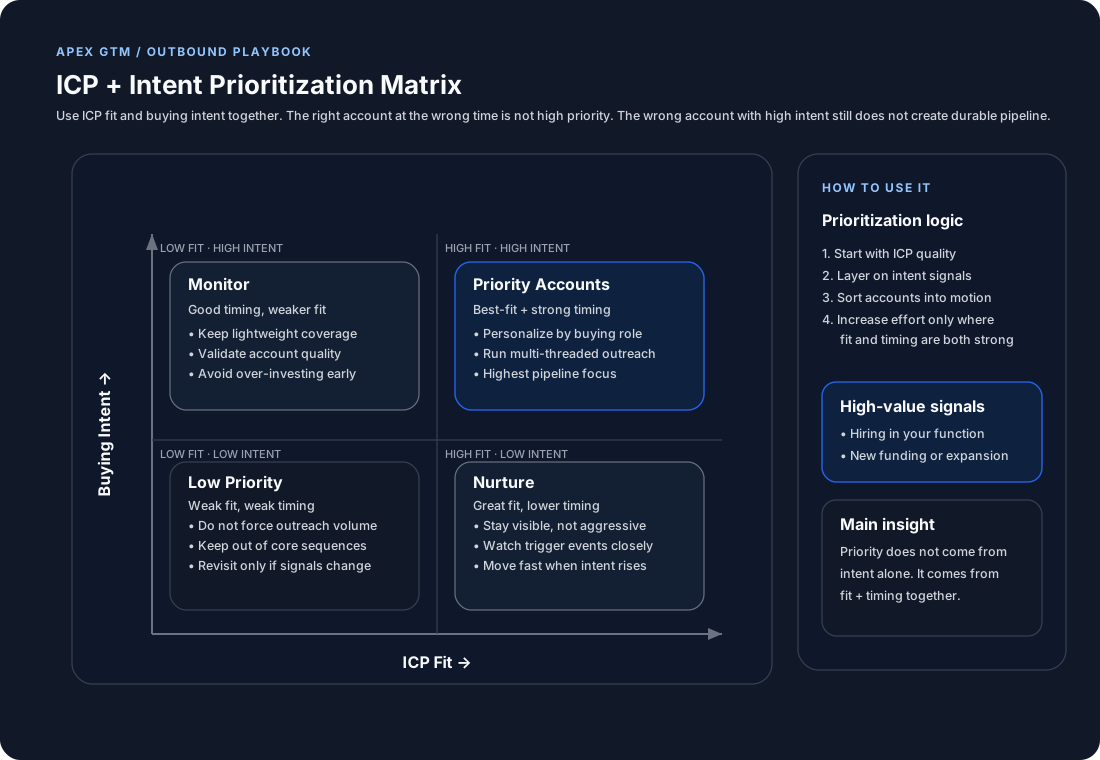
ICP and intent prioritization matrix showing how to score and tier target accounts by fit and buying signal strength

The output of this process is a tiered account list — not a flat list of names. Tier 1 accounts deserve more touchpoints and more personalization. Tier 3 accounts should get lighter-touch sequences until they signal movement.

Identifying the Right Personas

Outbound is not one contact per company. It targets a buying group.

For most B2B decisions, there are at least four roles worth mapping:

Economic Buyer

Controls budget. May not be the day-to-day decision maker, but nothing moves without their approval. Often a VP, CRO, CEO, or CFO depending on deal size.

Champion

Owns the problem internally. They feel the pain acutely and want to solve it. The champion sells the deal upward when you are not in the room.

End User

The people who will actually use the product. Their adoption and enthusiasm often determines whether a deal proceeds or stalls at evaluation.

Blocker / Stakeholder

The person who can slow or stop a deal — often IT, Legal, Finance, or a competing internal initiative. Ignoring this role costs deals late in the process.

Most outbound fails here not because the message is wrong — but because the wrong person received it, or the right person was never reached at all.

The Multi-Channel Outbound System

Outbound is not just cold email. It is not just cold calling. It is not just LinkedIn.

It is the combination — coordinated across channels so each touch reinforces the last. The channel that converts is usually not the first one. It is the fifth, because by then the name is familiar.

A practical coordinated sequence looks like this:

1

Day 1 — Cold email

Short, relevant, problem-aware. No pitch. Open a door.

2

Day 3 — LinkedIn connection or view

Lightweight signal. Adds presence without pressure.

3

Day 5 — Call

Brief, direct, referencing the email. Most people won't answer. Leave a tight voicemail if the target warrants it.

4

Day 7 — Follow-up email

Different angle. Add a new insight, data point, or relevant trigger. Not a "just checking in."

5

Day 10 — LinkedIn message

Direct, personal. Not templated. Acknowledges the sequence without being aggressive about it.

6

Day 14 — Final follow-up

Clean close. Acknowledge it's the last touch. Leave the door open. Some of the best responses come here.

Coordination beats volume. Consistency beats creativity. A disciplined sequence executed against the right accounts will out-convert a high-volume spray every time.
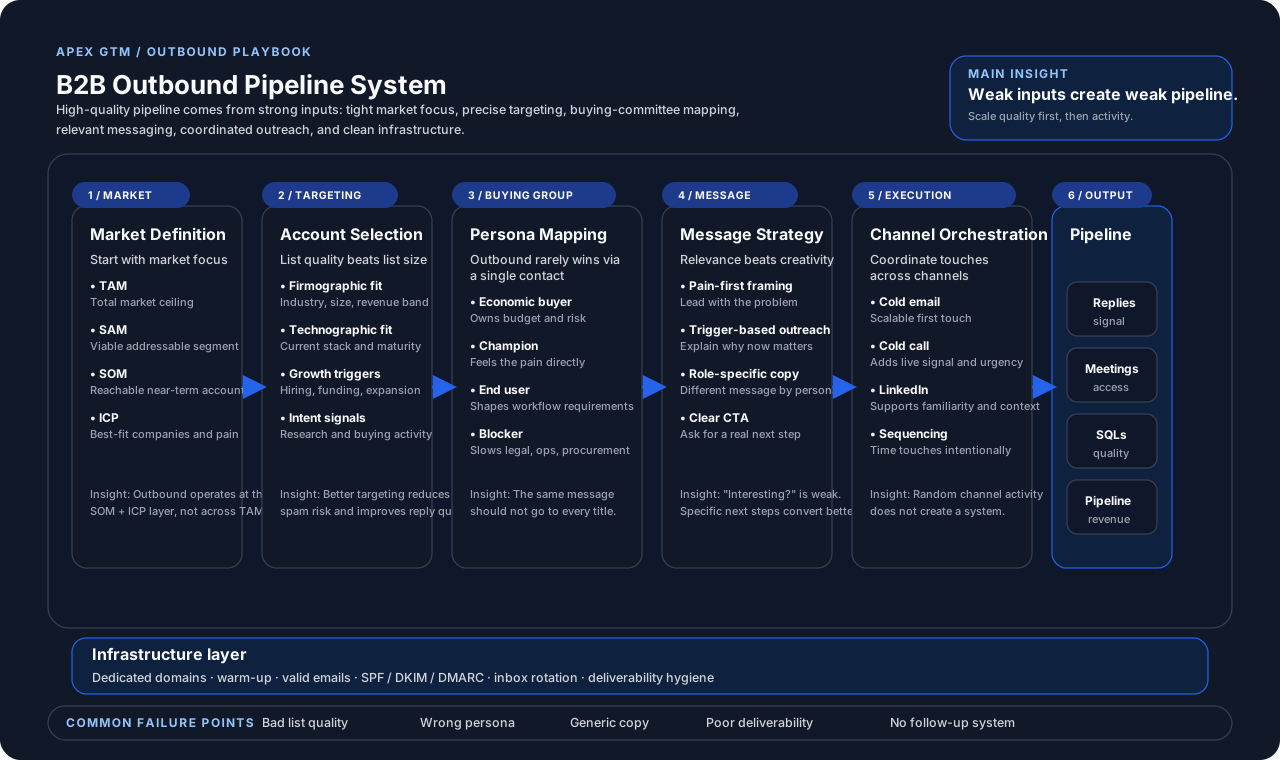
B2B outbound pipeline system showing account selection, multi-channel sequence, buying committee targeting, and pipeline output

Messaging That Actually Converts

Most outbound messaging is ignored because it is generic, product-first, or buried under fake personalization that reads worse than no personalization at all.

What works is messaging that is:

  • problem-aware, not feature-aware
  • relevant to where the buyer is right now
  • direct and specific, not vague and hopeful
  • tied to a trigger event or observable signal when possible

The difference is not subtle. Compare:

What Doesn't Work

"Wanted to reach out and see if you're interested in learning more about what we do…"

What Works

"Noticed you're hiring SDRs — most teams at that stage run into pipeline consistency issues before scaling headcount. Worth a conversation?"

Relevance beats cleverness. Clarity beats creativity. The best outbound messages don't read like marketing — they read like something a smart, observant colleague would send.

Over-personalizing is also a trap. Researching irrelevant personal details for fake rapport is obvious and adds friction. Personalize around the business situation — what is happening at the company that makes the problem urgent right now.

The best signal for message quality: could a real person have written this, or does it read like it was generated from a template? If the latter, the response rate will reflect it.

Outbound Infrastructure

Deliverability is not a technical detail. It is the foundation of the entire system.

If emails do not reach the inbox, none of the targeting, messaging, or sequencing work matters. The system fails silently while the team wonders why response rates are falling.

Infrastructure fundamentals that determine whether outbound actually works:

  • Dedicated sending domains — never send outbound from your primary company domain. Use dedicated domains that protect your brand reputation if deliverability degrades.
  • Domain and inbox warming — new sending infrastructure requires gradual volume ramp-up before any campaign goes live. Skipping this kills deliverability.
  • Inbox rotation — distribute volume across multiple inboxes to stay below sending limits that trigger spam filters.
  • SPF, DKIM, and DMARC — non-negotiable authentication setup on every sending domain.
  • Email validation — only send to verified, valid addresses. Bounce rates above 3–5% signal deliverability problems to providers.
  • Message variation — use enough copy variation across sends so campaigns don't trigger spam filters through identical pattern detection.
  • Ongoing hygiene — monitor reply rates, spam complaint rates, and inbox placement regularly. Deliverability degrades before you see it in response rates.

Common platforms that support outbound infrastructure include Smartlead, Instantly, Apollo, and Clay. The platform matters less than the hygiene discipline applied to it.

Deliverability = pipeline. An outbound system with poor infrastructure is not a pipeline system — it is an email exercise that produces nothing.

Common Outbound Mistakes

Most outbound underperformance traces back to a short list of recurring problems:

Volume over precision

Increasing send volume before fixing targeting, messaging, or infrastructure. More emails to bad lists produces more noise, not more pipeline.

Weak account lists

Lists built on job title filters alone, without firmographic precision or intent scoring. The result is high activity against accounts that will never convert.

Generic messaging

Templates that could apply to any company, any persona, any day. No specificity, no relevance, no reason to respond.

No ICP clarity

Running outbound against a fuzzy target because the Ideal Customer Profile hasn't been defined with enough specificity. Every downstream decision depends on this being right.

Infrastructure neglect

Skipping domain setup, warm-up, or ongoing deliverability hygiene. The pipeline numbers look fine until they collapse — and by then the sending domain is damaged.

Over-automation

Automating everything until the outreach feels robotic and depersonalized. Automation should handle logistics — not replace human judgment about who to contact and what to say.

How Outbound Connects to Pipeline

Outbound is not lead generation. It is controlled pipeline creation.

When built correctly, it feeds directly into:

  • qualified discovery conversations with the right buying committee
  • opportunities that match the ICP and have real urgency
  • revenue at a predictable cadence, regardless of inbound volume

That connection only works when outbound is treated as part of a larger go-to-market strategy — not a standalone tactic someone is running in a spreadsheet. The account list is derived from the ICP. The ICP is derived from market reality. The GTM motion defines how outbound and inbound work together. For companies building both sides of demand generation, the B2B Inbound Pipeline Playbook covers the complementary system in detail.

For companies where outbound is the primary pipeline channel, it is also one of the most important inputs to the demand generation channel strategy — because it has to carry a specific share of the pipeline target, and the economics need to support that load.

Most teams that struggle with outbound are not struggling with execution. They are struggling with a system design problem that experienced marketing leadership can diagnose and rebuild faster than iterating through another sequence test.

The Bottom Line

Outbound does not fail because it is outdated.

It fails because it is executed poorly — against bad lists, with generic messages, on broken infrastructure, with no system connecting the activity to revenue outcomes.

When done right:

  • the account list is precise and tiered by fit and intent
  • the buying committee is mapped and sequenced intelligently
  • the message is relevant to a real business situation
  • the infrastructure is clean and maintained
  • the activity is measured against pipeline created, not emails sent

That is when outbound becomes one of the fastest, most controllable ways to generate high-quality pipeline on demand.

If outbound isn't producing consistent pipeline, the issue is system design

Apex GTM helps B2B companies build outbound systems that target the right accounts, reach the right buyers, and convert into real opportunities — through consulting engagements or fractional marketing leadership. No spam. No fluff. Just pipeline.

Related Resources